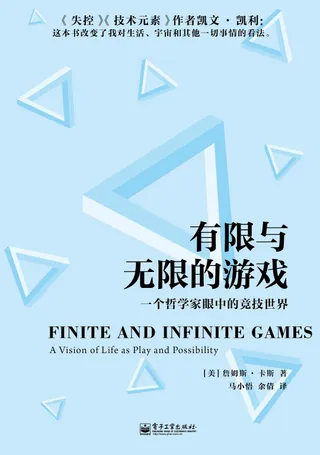
Finite and Infinite Games
Finite games seek victory; infinite games keep play alive. Reflections on boundaries, lifelong learning, and uncertainty.
This is the fourth book in this year’s Zhou Zuoluo book club. It is not an easy read, and my understanding is still rather superficial. Still, reading is worthwhile, and some of its ideas are worth exploring.
I. Overview
James Carse introduces two types of games in the world: finite games and infinite games.
A finite game is played to win; an infinite game is played to keep the game going forever.
Finite games are played within boundaries; infinite games play with boundaries.
A finite game has a definite beginning and end and a specific winner. Its rules ensure that the game will end. An infinite game has neither a definite beginning nor end, and no winner. Its purpose is to bring more people into the game itself, allowing it to continue.
II. Key Passages
2.1 Finite games aim at winning; infinite games aim at continuing play.
2.2 We enter many games without necessarily hoping to win, yet still compete for the highest possible ranking.
We should compete, not just to win: the process matters too.
2.3 Accepting internal limitations establishes the rules of a game. In every finite game, the participants’ agreement makes those rules effective.
Society is built this way too. Only with agreement can the game continue.
2.4 Unless creativity arises in the audience, art does not become art. Owning an art object is not the same as possessing art.
Buying books without reading them, or courses without watching them, does not mean you possess knowledge.
2.5 Patriotism flourishes only where boundaries are clear, hostile, and dangerous.
We should not follow any ideology blindly.
2.6 In terms of causality, there is nothing new under the sun: endlessly emerging knowledge follows variations of known natural laws.
2.7 Winners do not converse with losers; they speak for them.
History is also written by the winners. History is a little girl anyone can dress up as they please.
2.8 God breathes life into our bodies, but to continue living, we must breathe for ourselves.
A master can show you the door, but practice is up to you.
2.9 When one voice is amplified too much, it makes all other voices inaudible. We listen to a loudspeaker not because we want to hear what it says, but because it is the only voice that can be heard.
That is how authoritarianism works.
2.10 People use machines to control things, only to be controlled by machines.
Phones are like this too. Modern people have become slaves to their phones.
III. Conclusion
After reading this book, I feel I should invest more in infinite games, such as building a habit of lifelong learning. We should stop assuming that once we have “made it,” we are secure. Instead, embrace uncertainty and keep learning to adapt to a society that changes every day.