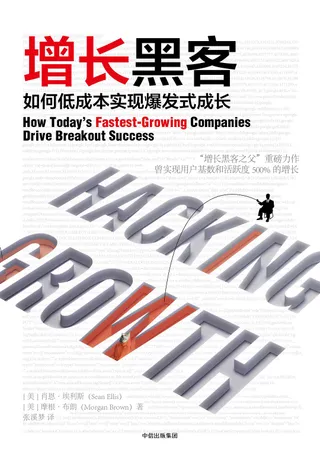
Hacking Growth
Built around acquisition, activation, retention, and monetization: how cross-functional growth teams use data and rapid experiments to drive growth.
This is the fifth book of this year’s Zhou Zuoluo reading club. It’s mainly about product growth, and for a programmer like me it’s genuinely worth reading.
1. Overview
Hacking Growth is written by Sean Ellis, who coined the concept. Using real cases from companies like Facebook and Airbnb, it systematically explains how to break through the boundaries of traditional marketing and drive growth with data analysis and technology.
The book is built around the user lifecycle of “acquisition, activation, retention, and monetization,” explaining in detail how to build a cross-functional growth team and how to quickly find product-market fit (PMF) through A/B testing.
For readers who want to understand how internet companies use technology and data to achieve exponential expansion, it’s a rare methodology handbook.
2. Favorite Quotes
On growth hacking
-
Growth hacking is really about teamwork. The greatest successes come from combining programming, data analysis, and marketing experience, and very few people master all of these skills.
-
The growth team should be involved in every stage and every aspect of the growth effort, whether achieving product-market fit or user acquisition, activation, retention, and monetization.
-
Cross-functional collaboration and information sharing are key principles of growth hacking.
-
Rapid-fire experimentation is a hard requirement of the growth hacking process.
AI has made it possible for individuals to build and ship products fast.
-
Remember, the big wins of growth hacking usually come from an accumulation of small wins.
Advance one pawn a day; no effort is ever wasted.
-
One advantage of growth hacking is that even failed experiments bring the team important lessons in a very short time.
Other
-
Support from the top of the organization is vital for a team’s sustained success.
-
Success is the most effective way to resolve conflicts and disagreements.
-
Even a truly great product, even one loved by a core group of early users, is likely to fail without an all-out effort to drive growth.
-
A good plan violently executed today is better than a perfect plan tomorrow.
Execution matters. Best to start today and learn by doing.
-
Not adding any friction for users doesn’t always work; often you need to give users a reward.
You need a “shameless” spirit and keep nudging your customers.
-
Most of the work of resurrecting lapsed users is done through email and ads.
So a newsletter matters: Resend or Beehiiv.
-
Companies should consider having more products with limited but more specialized features, rather than cramming every possible feature into one product.
all in one = all in boom
-
Users are not as price-sensitive as you think.
Price boldly, especially for products aimed at overseas markets; users abroad have better paying habits.
3. Summary
If you don’t get positive feedback from something, it’s hard to keep going. So when beginners build websites, they should target new and trending keywords, launch fast, and use some of this book’s methods to acquire users and monetize.
Rapid experimentation is a hard requirement of growth hacking, and building websites needs speed too: even if it’s just a landing page, capture the traffic first, then keep iterating. Even if the results aren’t good, that’s fine. At least we gain experience in the process, and next time we launch a site we’ll handle it with more ease.