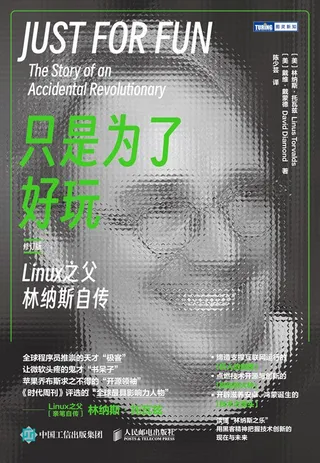
Just for Fun
The autobiography of Linux's creator: building Linux out of pure curiosity, and Linus's Law of survival, social order, and entertainment.
I read this book right after Bill Gates’s Source Code: having read about Windows, I figured I’d look at Linux. Its writing is as poor as Source Code’s; maybe these titans just aren’t good writers. But the ideas in the book are still well worth learning from.
1. Overview
Just for Fun is the autobiography of Linus Torvalds, the “father of Linux.” Unlike the many tech-titan biographies full of business strategy and myth-making, this book tells, with distinctly “geeky” humor and candor, how an introverted Finnish boy, purely out of curiosity about how computers work at the lowest level, accidentally typed out the world-changing Linux operating system in his bedroom.
There is no grand narrative of business ambition; instead the book focuses on Linus’s pure love of and focus on technology. It not only recounts the birth of Linux and Git and the rise of the open-source spirit, but at its core puts forward Linus’s unique philosophy of life, “Linus’s Law”: human evolution starts with survival, passes through social order, and ultimately leads to entertainment. For him, programming and creating are not about conquering the world; the driving force is, as the title says, just for fun.
2. Favorite Quotes
-
There are three things that have meaning in life. They are the motivations for everything in your life, everything you do and everything a living thing does. The first is survival, the second is social order, and the third is entertainment.
Finding the meaning of life matters. The blandness of everyday life wears down all your ambition, so beyond making a living, you should do the things that are hard but right.
-
Without a project to work on, you lack passion. You’re always looking for something that can get you fired up.
-
One of the reasons Linux keeps getting better and more vibrant is that I constantly get feedback.
Projects and side hustles need feedback; otherwise it’s hard to keep going. Perseverance or willpower alone never lasts.
-
That summer I did two things. The first was nothing. The second was reading the 719 pages of Operating Systems: Design and Implementation.
-
It took me about a month or so to do this, because I had to learn as I went.
Even someone as strong as Linus has to keep learning; ordinary folks like me need to work twice as hard.
-
Simplicity requires special design and very good taste.
-
To make Linux the most perfect technology, it has to stay pure.
This idea is a lot like Jobs’s: the greatest truths are the simplest. Keep things simple enough, including the things you use in daily life, because extra stuff drains your attention.
-
The best leaders don’t make their people do what they’re told; they let them do what they themselves want to do.
-
If you spend more time sleeping, you do lose some working hours, but if you sleep well, when you’re awake your mind is clearer than everyone else’s.
Sleep matters. 7 hours a day / 50 hours a week is my bottom line.
-
I hate giving speeches, but I hate giving bad speeches even more.
Preparation brings success; lack of it brings failure. You can’t avoid doing something just because you hate or fear it. The key is thorough preparation and repeated deliberate practice.
-
Intellectual property laws are not used to promote innovation, but to control markets and control what consumers can and cannot do.
-
People do their best work when they are driven by passion and enthusiasm.
Either turn your work into a hobby, or turn your hobby into your work.
3. Core Ideas
Here I’m quoting an article from Baoyu’s blog, which excerpts some of Linus’s core ideas. I’ve excerpted part of it.
Original link: https://baoyu.io/translations/beauty-programming
Programming is, at its core, a practice of creativity.
What first drew me into programming was figuring out how computers work inside. One of the greatest joys was discovering that computers are a lot like mathematics: you are free to create a world with its own rules. In physics, you are constrained by the rules of the real world, but in math and programming, anything is possible as long as it’s logically consistent. Math doesn’t have to match the logic of the outside world; it just has to be consistent within itself. As any mathematician knows, you can even create a world where “3 plus 3 equals 2,” as long as it’s internally consistent. But as complexity grows, you have to be careful not to create contradictions in the world you’ve built. A beautiful mathematical or programming world cannot tolerate any flaws.
One reason people love computers is that they let you experience one brand-new world after another that you created yourself, and witness endless possibilities. Math lets you imagine all kinds of wonderful setups in your head. Take geometry: most people think first of Euclidean geometry, but with computers we can easily and intuitively experience geometric worlds completely different from Euclid’s. Remember the famous Mandelbrot set? Those gorgeous fractal images are just a world the mathematician Mandelbrot imagined out of thin air, completely abstract and unrelated to the real world. Yet they unexpectedly produced utterly mesmerizing patterns. Without computers, these purely mathematical worlds could never be seen. Computers and programming let you create new worlds, and sometimes the patterns in them are extraordinarily beautiful.
Of course, most of the time you’re not creating a whole new world. You’re just writing a program to do a specific task. In that case you’re not creating a world, but solving a problem within the computer’s world. You have to sit quietly in front of the screen and rack your brain to find the answer. And probably only geeks like me have the patience to stare at a screen and think hard.
The operating system is the foundation on which all programs run, and developing one is the ultimate challenge. Creating an operating system means creating a “world” inside the computer. You set the rules and decide what’s allowed and what isn’t. Every program defines its own rules, but the operating system is the most fundamental. It’s like a country’s “constitution,” while other programs are more like specific laws.
4. Summary
Programming in China is still different from programming abroad. Abroad there are still people like Linus who love programming; in China there may be fewer, and more people treat programming as a way to make a living.
I started learning programming in 2014, and after graduating in 2018 I began programming for a living. I can hardly say I love programming, but at least I don’t hate it; I like it fairly well. I also like fun programming that feels cool to use. Even more, I like the positive feedback I get from products built with code!