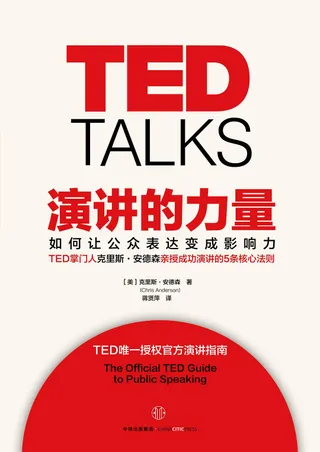
TED Talks: The Official TED Guide to Public Speaking
From fearing public speaking to understanding effective communication and sincerely sharing valuable ideas.
I am an introvert, and I am very afraid of speaking in front of a group. Whenever I have to do it, I find both the preparation and the nervousness of speaking extremely painful. Last year I saw Liu Run recommend this book, so I decided to read it and see whether it could help. After three months of intermittent reading, I finally finished it.
I. Overall Impressions
As someone born in the 1990s, I am no stranger to speeches. When I was at school, authors selling books often came to speak. Their passionate delivery stirred us into buying books we would never open afterward.
In my first year of high school, the school organized a speech about gratitude. We all knew the speaker was there to sell books. I thought, “Who would buy these?” Thick fog suddenly appeared that morning, adding a mysterious atmosphere. The school had invited every student’s parents, and my mother came too. I barely remember the speech, but I remember one thing: I went up on stage.
It was not for anything glorious. The speaker asked which students had been to internet cafés and whether they dared to stand on stage. As an introvert, I would never normally have dared. But his powers of persuasion were so strong that I grew restless in my seat and eventually found myself up there.
Then, together with a group of internet-addicted teenagers, I kept shouting, “I will never go to an internet café again!”
Looking back, it still seems ridiculous. Yet at the time I really was swept up by the speaker, involuntarily doing something I normally would not do and would not dare to do.
Back to the book: written by TED’s leader, it covers public speaking comprehensively, using real talks from the TED stage as examples. I watch TED too, mainly to learn English. I have its app on my iPhone and Apple TV. The talk I remember best was by a cyclist who crossed the United States, roughly from the East Coast to the West Coast. While describing that achievement, he shared many interesting things he had seen and heard. Sharing like this is meaningful and fills us with hope for life.
II. Selected Passages
1. Communication cannot happen when people do not want to listen or are unwilling to listen.
2. A good explanation stops at the right point, leaving people feeling that they discovered the concept themselves.
3. In the frenzy of the attention economy, people welcome concise, powerful talks and have no patience for long-winded ones.
4. The secret of happiness is to find something more important than yourself and dedicate your life to it.
Finding meaning in life matters. Work is not always exciting; we need something that makes us feel valuable.
5. The core of speaking and writing is effective—and efficient—communication.
6. A good, precise analogy builds a virtual bridge across the gap between the known and the unknown, helping thought cross it.
7. The sole purpose of a talk is to share valuable ideas, sincerely and in your own unique way.
8. I absolutely must not talk about everything I love. Much as I want to pour it all out, those things are not the focus of the narrative.
Do not impose on others what you dislike; do not impose what you like either.
9. Knowledge cannot be stuffed into a brain; the brain must absorb it.
10. When people sit down to listen to you, they give you something precious that cannot be taken back: their time and energy.
So prepare properly and make your sharing worthwhile.
III. Conclusion
Writing and speaking are both core skills I need to keep practicing. I will keep writing and later try sharing through videos too.
In short, learn to communicate effectively, be yourself, and share meaningful ideas. That is how life should be—and it should be that simple.