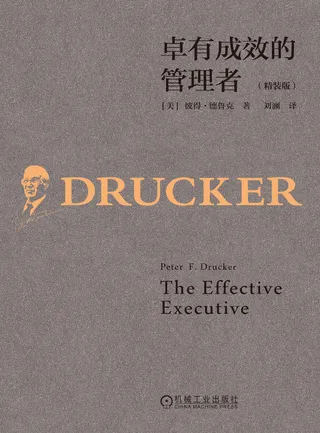
The Effective Executive
Drucker's management classic: effectiveness is a learnable set of skills and habits: first things first, build on strengths, make effective decisions.
This is the sixth book of this year’s Zhou Zuoluo reading club. At a company meeting a while ago, our HR director specifically mentioned this book, so reading it with the club was a good chance to learn from it.
1. Overview
The Effective Executive is a classic by Peter Drucker, the “father of modern management,” and is regarded as a landmark in the field. Drucker breaks down traditional hierarchical boundaries, arguing that anyone who is responsible to an organization and can affect its results is an executive. The whole book runs on one striking core belief: effectiveness is not an innate gift, but a set of skills and habits that can be learned. Drucker stresses that an executive’s core mission is not only to improve efficiency, but to “do the right things” through self-management, ultimately enabling ordinary people to achieve extraordinary things.
The book systematically lays out concrete paths to effectiveness, offering highly practical guidance for knowledge workers. Drucker points out that executives must turn passive time consumption into active time management, insist on “first things first,” and focus on only one most important thing at a time. In staffing and decision-making, effective executives focus on contribution and external results, make use of people’s strengths rather than dwelling on their weaknesses, and through effective communication and decision mechanisms grasp the essence amid complex information, creating real value and new ideas in the organization.
2. Favorite Quotes
Knowledge workers
- The defining trait of knowledge workers is their independence: they can actively integrate resources, create value, and bring about economic, social, cultural, and even political change.
- Knowledge workers must manage themselves, consciously completing their tasks, making contributions, and pursuing effectiveness at work.
- Every knowledge worker in an organization today must be a decision-maker, or at least play an active, intelligent, and autonomous role in the decision-making process.
Time management
- Every knowledge worker, and especially every executive, must be able to use time in large blocks to be effective.
- Executives who don’t know how they use their time can forget about managing it.
- To understand how time is spent, and manage it accordingly, we must first record it.
- Time is the scarcest resource. Unless time is managed, nothing else can be managed.
Decision-making
- An effective decision-maker either acts or doesn’t act; he does not take half-action.
- Taking half-action is the one thing that is always wrong: it fails to meet the minimum specifications and boundary conditions.
- As long as a decision is right, there is no reason to back away from it because it is difficult, frightening, or troublesome to carry out.
Management
- Effective executives need to practice managing themselves, managing upward, and understanding how a function fits into the whole organization.
- Managing your boss is more important than managing your subordinates.
- Making strengths productive is a quality every effective executive must have; it is the key to whether an organization works, and indispensable to knowledge workers and to society.
- Executives must improve their knowledge and skills, form new work habits, and also give up old ones.
Other
- Human nature is weak and cannot withstand the temptations and tests of power.
- Temporary things often become permanent.
- If someone has a lot of experience in an area yet no insight, it means they lack keen observation and are slow-witted.
- We can only make full use of people’s abilities by improving the means of work, not by hoping their abilities will suddenly improve.
- A person who values contribution and takes responsibility for results, however junior, should count as “top management,” because he is responsible for the performance of the whole organization.
- Meetings should be an unavoidable exception, not the rule.
3. Summary
Management skills are not exclusive to managers and leadership. In the AI era, everyone needs them.
To use AI well, you need management skills: knowing which specific AI tool to choose for which specific task. That’s a crucial skill for a one-person company.